 Law firms have worried about online reviews for a long time. I wrote about this years ago in Obtaining Online Reviews for Your Law Firm. The basic point remains true: online reviews are not going away, and law firms that obtain business from the internet cannot simply ignore them.
But there is a major difference between recognizing the importance of reviews and believing every review platform deserves the same amount of attention. That brings me to Yelp.
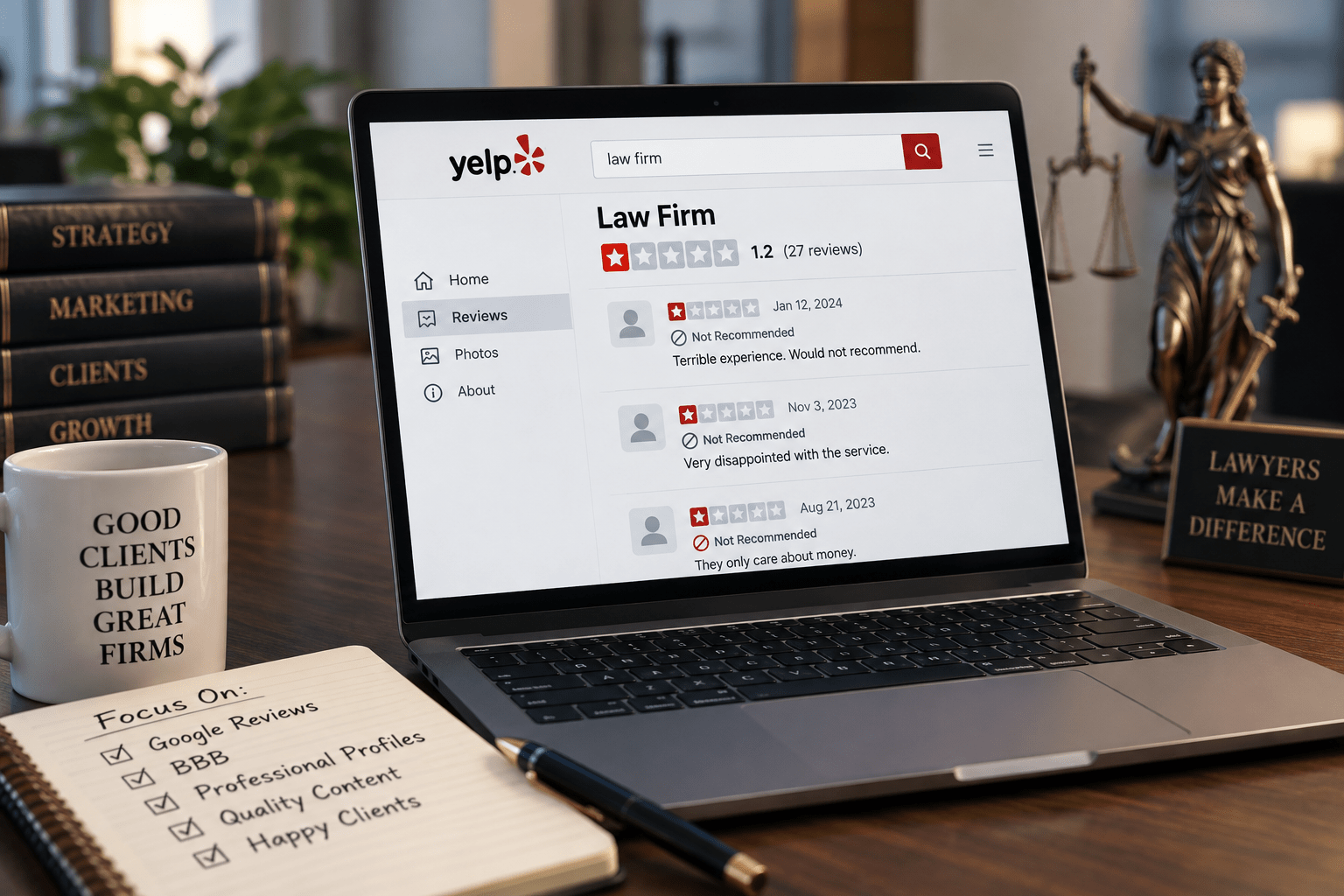
For many law firms, Yelp may be one of the most frustrating places to spend reputation-management time and money. Every firm handling a significant volume of cases will eventually have unhappy clients. What makes Yelp particularly difficult is that it discourages businesses from asking clients for reviews while also using recommendation software to determine which reviews count toward the displayed rating.
For law firms, that combination can result in Yelp ratings that look substantially worse than the firm’s reputation on Google, the Better Business Bureau and elsewhere online. Law firms should keep that in mind when deciding where to spend their limited marketing resources.
Law Firms Already Have a Difficult Online-Review Problem
Legal services are unusual. A lawyer can provide excellent representation and still have an unhappy client. The judge may rule against the client. The opposing party may be unreasonable. Litigation may last longer than anybody expected. Attorney’s fees may become substantial. A client may have expectations that the law simply does not permit the lawyer to fulfill. The lawyer does not control all of those things, but the lawyer can still receive the one-star review.
I addressed another part of this problem previously in Should You Respond to Negative Reviews Online?. Lawyers have confidentiality obligations that can severely limit how they respond when a former client posts an incomplete or inaccurate account of what happened. A restaurant, retailer or contractor may be able to publicly explain the other side of a dispute. A lawyer frequently cannot.
This means law firms already face disadvantages in online reviews. Yelp’s model can magnify them.
Yelp Makes It Hard to Build a Representative Review Profile
Most businesses build reviews in a straightforward way. They provide good service and then ask satisfied customers for honest feedback. Law firms can use reputation-management software to make that process easier by sending clients a polite email or text with a convenient review link.
Yelp discourages businesses from asking customers for Yelp reviews. That matters because unhappy clients generally do not need to be asked. The angry former client who wants to complain about a lawyer will find a place to do it. A satisfied client typically finishes the legal matter and gets on with life.
Even if a satisfied client independently posts a Yelp review, the review may not affect the firm’s displayed rating. Yelp uses automated recommendation software to determine which reviews are recommended.
This can produce frustrating results. A legitimate client can write a detailed review explaining that an attorney was professional, responsive, knowledgeable, compassionate or helpful, and the review can still end up in the “not recommended” section. Even lengthy reviews containing considerable detail and descriptive language can be excluded.
For some law firms, it can appear that most of their favorable Yelp reviews are not recommended. Whether every excluded review should have counted is impossible for the firm to determine. The broader problem is that dissatisfied clients are naturally motivated to complain while the firm has limited ability to encourage satisfied clients to participate, and some of the favorable reviews that do appear may not affect the headline rating.
It should therefore not be surprising when a law firm’s Yelp rating looks considerably worse than its ratings elsewhere.
Businesses Have Complained About Yelp for Years
The frustration is hardly limited to lawyers. Businesses have complained about Yelp’s review and advertising model for years, and some of those complaints have resulted in litigation.
In Levitt v. Yelp! Inc., business owners alleged that Yelp manipulated reviews to pressure businesses into purchasing advertising. Among the allegations was a claim that positive reviews disappeared after a business declined to advertise. Another plaintiff alleged that 77 reviews had been filtered, 75 of which were positive.
Those were allegations, not findings of fact. The Ninth Circuit ultimately affirmed dismissal of the plaintiffs’ claims and did not find Yelp liable for extortion. The Ninth Circuit’s decision in Levitt v. Yelp! Inc. is worth reading because it shows both the nature of the business owners’ complaints and the legal outcome.
There is no basis for simply claiming that Yelp removes positive reviews because a business refuses to buy advertising. At the same time, law firms can legitimately question whether they want to spend advertising dollars promoting a profile they believe does not accurately reflect their overall client experience.
Google and the BBB Are Not Perfect Either
Law firms complain about Google reviews. They complain about the Better Business Bureau, too. There can be frustrating reviews, difficult complaint processes, questions about what should or should not remain online and situations where a law firm believes a platform has gotten something wrong.
Neither Google nor the BBB is perfect.
But compared with Yelp, they can look pretty good.
With Google, law firms at least have a practical opportunity to build a broader body of legitimate client feedback. Potential clients are already using Google to search for lawyers, and reviews are connected directly to Google Business Profiles, Maps and local search results. Firms can ask clients for honest feedback consistent with Google’s policies and applicable professional rules, making it possible for satisfied clients as well as dissatisfied clients to participate.
This also connects to local search. I previously discussed the importance of local visibility in Are You in the Three-Pack in Google Maps?. Reviews are not merely about reputation. They are part of the broader online ecosystem through which prospective clients discover and evaluate law firms.
The BBB has its own frustrations, but it also provides another recognizable source through which consumers can evaluate a business. Law firms can maintain their profiles, participate in the complaint process and give prospective clients another source of information beyond a single review directory.
Law firms may occasionally be unhappy with Google or the BBB. That comes with having a significant online presence. But at least a law firm has a fighting chance on those platforms. On Yelp, restrictions on asking for reviews and the recommendation filter make developing a representative rating much harder.
Professional Profiles and Social Media Matter Too
A law firm’s reputation is much larger than reviews. Prospective clients can research individual lawyers through professional directories and recognition programs such as Super Lawyers. They can look at professional biographies, education, experience, publications, speaking engagements, bar activities, and other credentials.
They can also examine what a firm publishes and how it interacts with the public through Facebook, LinkedIn, YouTube and Instagram. These sources provide context that a simple star rating cannot.
Law firms should also continue developing their own websites. Detailed attorney biographies, useful legal articles, office pages, videos, podcasts, news coverage and other substantive content all give prospective clients additional information with which to evaluate the firm.
I have written previously about whether online legal directories are useful and why firms should pay attention to search engine optimization. The same principle applies to reputation management: a law firm should not allow any one third-party website to control what prospective clients learn about it.
ChatGPT Makes the Broader Internet Even More Important
Artificial intelligence adds another dimension. Consumers increasingly have the ability to ask tools such as ChatGPT about businesses rather than manually reviewing one directory at a time.
A prospective client can ask an AI system about a lawyer’s experience, professional credentials, locations, online reviews and other information. Search-enabled AI can gather information from multiple web sources and direct users toward those sources.
That makes the entirety of a law firm’s digital footprint increasingly important. A firm should want search engines, AI systems and prospective clients to find its official website, attorney biographies, Google Business Profiles, BBB information, Super Lawyers and other professional profiles, social-media accounts, news coverage, legal articles, videos, podcasts, and speaking engagements.
The objective should be to create legitimate, useful and authoritative information that deserves to rank when someone researches the firm. The stronger the firm’s overall digital footprint becomes, the less power any one directory has to define it.
A Practical Yelp Action Plan
Law firms should keep their Yelp listings accurate, monitor new reviews, look periodically at the “not recommended” reviews and respond professionally when ethical obligations permit. Yelp advertising should be judged like any other marketing expense: if it produces worthwhile clients at an acceptable cost, that matters; if it does not, firms should be willing to spend those dollars elsewhere.
Meanwhile, put more reputation-management energy into Google, the BBB, the firm’s website, professional profiles, social media and other credible sources. Periodically search the firm’s name and look at the results as a prospective client would. The goal is to create enough credible information that no single website dominates the firm’s online identity.
Make Yelp Less Important
Law firms have limited marketing dollars and management time. The better long-term strategy is to build a broad digital reputation rather than devote disproportionate resources to one platform.
As I wrote years ago in Obtaining Online Reviews for Your Law Firm, online reviews are not going away. What has changed is the number of places where prospective clients can research a lawyer and the technology they can use to do it.
Google isn’t perfect. The BBB isn’t perfect. Law firms will complain about both from time to time. But compared with Yelp, they can look pretty good because law firms at least have a reasonable opportunity to participate and build a broader picture of their client experience.
Google matters. The BBB matters. Professional profiles matter. Social media matters. A firm’s own website and substantive content matter. And as AI-powered search becomes more prevalent, the overall quality and authority of a law firm’s online footprint will matter even more.
Yelp can remain one piece of that picture. It does not have to define it.
If you have any thoughts, feel free to share them below.