 After nearly twenty years of running a business, one lesson becomes increasingly clear: surrounding yourself with knowledgeable people is essential. No business owner can know everything, nor should anyone try. That’s why businesses hire accountants, attorneys, consultants, technology professionals, financial advisors, and other specialists.
They’re hired because the business needs help.
At least, that’s the theory.
Sometimes, hiring an expert feels a little like calling a plumber about a dripping faucet and being informed that the entire house needs to be demolished, the family should relocate, and a structural engineer will be joining the next call.
What began as one problem has now become seventeen, complete with three new professional relationships and a recurring Thursday meeting.
The faucet is still dripping.
The Wonderful World of Outside Experts
Knowledgeable professionals are invaluable. Some of the best decisions business owners make come from listening to people who understand something better than they do. As previously discussed in Are You Getting Your Practice Management Advice From the Right Source?, the source and quality of professional guidance matter.
But certain experts possess an extraordinary ability to turn almost any relatively straightforward assignment into a project of historic proportions.
A question is asked. Fourteen documents are requested. The documents are provided. A meeting is scheduled. At that meeting, another specialist is recommended, who naturally needs fourteen more documents and a separate introductory meeting.
Eventually, someone suggests forming a committee.
Apparently, NASA is being rebuilt. The original objective was simply to improve a business process.
At some point, the business owner begins wondering whether the original problem was really that serious or whether an entirely new industry has accidentally been created.
A Simple Question Has Become a Scavenger Hunt
Another remarkable feature of working with certain outside experts is how rarely a relatively straightforward question produces a relatively straightforward answer.
A business owner asks, “What would you recommend?”
A reasonable question, presumably.
Instead, the answer involves locating documents, contacting people, retrieving historical information, and consulting additional professionals before anyone can offer a recommendation.
It’s less like receiving professional advice and more like participating in a corporate scavenger hunt. Unfortunately, there are no prizes, nobody provides a map, and the entry fee is billed hourly.
Completing the first set of assignments merely unlocks Level Two.
Congratulations! Please locate an email from eight years ago, identify three people who may or may not still work for the organization, and arrange a meeting with someone whose involvement has not yet been explained.
Once those tasks are complete, another call can be scheduled to discuss whether everyone is finally ready to answer the original question.
By then, nobody remembers the question. But the scavenger hunt is progressing beautifully.
To be fair, some questions genuinely require investigation. Thorough professionals should never guess when additional information is necessary. But there’s also value in helping clients understand what information matters, why it matters, and what can reasonably be accomplished in the meantime.
Sometimes, even a preliminary answer would be refreshing.
Or perhaps a hint. Every good scavenger hunt should have one.
Perhaps Everyone Could Get Acquainted Before the Sentencing?
One of the most valuable qualities in a professional relationship is an advisor who takes the time to understand the organization being advised.
Every business has a history, a culture, financial realities, employees, clients, and competing obligations. Decisions are rarely made in a vacuum. There are usually reasons things developed the way they did, even when improvements are warranted.
Occasionally, however, an outside expert seems ready to deliver a comprehensive diagnosis before learning much about the patient.
Two emails have been exchanged, half a telephone conversation has occurred, and somehow everyone has already arrived at the verdict.
No need to interview witnesses. The prosecution rests.
Nobody is suggesting that every professional engagement requires six months of relationship-building, a weekend retreat, or exchanging Christmas cards. But perhaps a few questions could precede the sweeping conclusions.
What is the organization trying to accomplish? Why are things done a particular way? What resources are available? What has already been attempted? What other obligations are competing for attention?
And here’s a particularly radical suggestion: Listen to the answers.
Sometimes, the person who has spent years operating the business might actually know something useful about it.
Admittedly, a controversial position.
Apparently, the CEO Is Supposed to Know Everything
Another fascinating aspect of working with outside experts is the occasional assumption that the person running the organization should already understand every subject the expert was hired to address.
Apparently, a CEO or law firm owner is supposed to be an accountant, technology specialist, human resources professional, financial analyst, marketing expert, compliance professional, and attorney all rolled into one.
Preferably with advanced degrees in each discipline.
And when a question arises about something outside the owner’s area of expertise, the response can occasionally suggest that the answer should have been obvious all along.
Well, that’s awkward. Wasn’t that the reason for hiring the expert?
No CEO, business owner, or managing partner can possibly know everything about every aspect of an organization. Everyone has different educational backgrounds, professional experiences, strengths, and weaknesses. Some people are tremendous with numbers. Others excel at managing people, developing business, solving technical problems, practicing law, or building relationships.
A successful organization needs all those skills. They rarely reside in one human being.
A law degree, for example, generally does not arrive accompanied by a doctorate in accounting, a master’s degree in information technology, and an engineering certification. Perhaps those diplomas are mailed separately.
Recognizing limitations isn’t a failure of leadership. It’s one of the reasons businesses build teams and seek outside expertise in the first place.
Nobody would reasonably expect an accountant to walk into a courtroom and handle a complicated trial simply because they’re an intelligent professional. Likewise, a business owner should be able to seek guidance on a subject outside their training without being treated like they skipped an entire semester of Business Ownership 101.
Everyone knows different things. That’s supposed to be the beauty of working together.
Not an opportunity to determine who gets to wear the tallest intellectual hat.
A Solution Was Requested. Somehow, a 47-Point Action Plan Arrived.
Another fascinating feature of the consulting universe is the tendency to treat every issue as though it requires a complete organizational transformation.
Sometimes, a relatively modest improvement would do the trick. But modest improvements don’t always lend themselves to impressive presentations.
Instead, there are phases, subphases, implementation committees, strategic frameworks, stakeholder alignment sessions, and proposed timelines extending well into the next presidential administration.
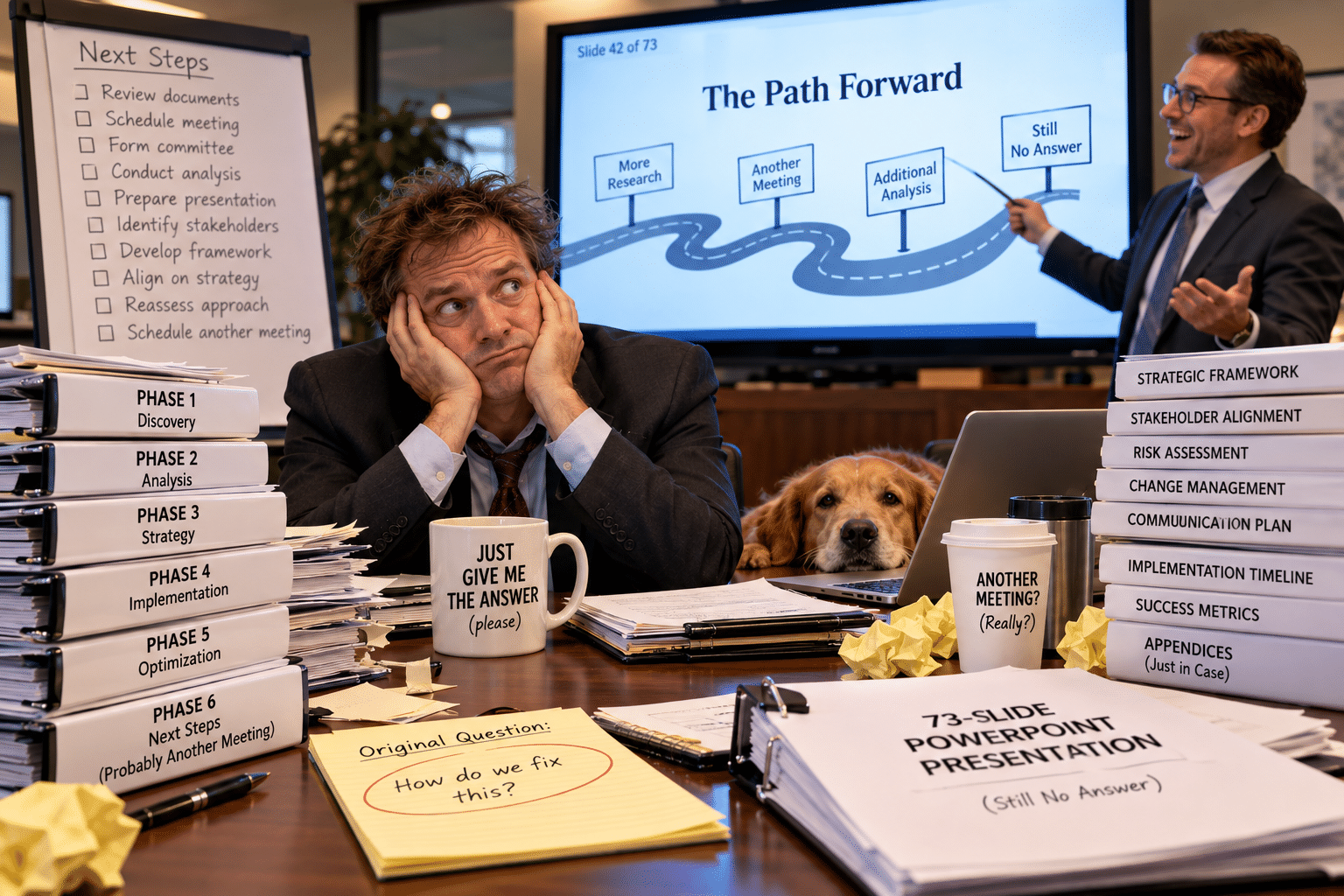
Eventually, someone unveils a 73-slide PowerPoint presentation explaining why the original question cannot yet be answered.
Slide 42 is titled The Path Forward.
Unfortunately, the path forward appears to lead to another meeting.
Thoroughness is important. Some matters genuinely require extensive analysis, careful planning, and substantial corrective work. But good professional judgment also involves proportionality.
Not every issue requires a moon landing.
Harvard Business Review addressed the broader importance of effective consulting in its article, Consulting Is More Than Giving Advice. Effective consulting extends beyond identifying issues and delivering recommendations. It should help clients achieve meaningful results.
Apparently, this subject has been discussed for more than forty years.
Perhaps a task force should be formed to determine why.
The CEO’s Calendar Is Not a Community Recreation Center
Another quality worth appreciating in outside professionals is respect for time.
Business owners have employees to manage, clients to serve, decisions to make, financial responsibilities, and occasionally a family that would like to see them before retirement.
Yet some professional engagements seem to operate on the assumption that the client’s primary responsibility is being available for the next meeting.
Could everyone meet tomorrow? What about Thursday? Perhaps a quick call Friday? Another two hours should probably be reserved next week to discuss the action items from the previous discussion.
And, of course, there’s the famous phrase: “This should only take fifteen minutes.”
Fifteen minutes in consultant time apparently operates similarly to dog years.
Then there’s the particularly cherished Friday afternoon financial emergency.
Picture a business owner who readily acknowledges that finance is not their strongest subject. Their educational background is in another field, which is precisely why a financial professional was hired.
At approximately 4:37 p.m. on Friday, an urgent call is requested. Apparently, the weekend cannot begin until the business owner receives an advanced seminar on financial concepts that could make a university accounting professor reconsider their career choices.
The discussion begins with a question about whether the owner understands the underlying financial principles. The owner does not. This is unfortunate because the next forty-five minutes will apparently be devoted to explaining why understanding those principles is essential.
There may be acronyms. There may be formulas. At some point, a spreadsheet is introduced, followed by a second spreadsheet to explain the first spreadsheet.
The business owner, whose brain left the office approximately twenty minutes earlier, is now mentally standing in the driveway holding a suitcase.
Meanwhile, the expert is just getting warmed up.
The truly impressive part is that the original question still hasn’t been answered. But everyone has received a complimentary graduate-level lecture, and the weekend has been successfully neutralized.
A financial professional’s expertise is valuable. So is knowing the difference between an actual emergency and something that could be explained in a thoughtful email or discussed Monday morning.
If the building is on fire, by all means, call Friday afternoon. If the subject is the finer points of financial planning, perhaps civilization can survive until Monday.
Business owners hire financial professionals for guidance, not substitute teachers determined to make sure nobody leaves class before the bell rings.
As discussed in Every Day Matters in the Life of a Law Firm, time is one of the most valuable resources in running a business.
Sometimes, the most helpful thing an expert can do is send a concise email, provide a recommendation, and let everyone get back to work.
Not every question needs a summit.
A Good Consultant Should Lower the Room Temperature, Not Raise It
Another valuable quality in outside professionals is the ability to lower the temperature in a room rather than raise it.
Business owners already have plenty to worry about. When outside help is brought in, the objective is generally to obtain clarity, perspective, and a path forward. The objective is not necessarily to have someone arrive, sound every available alarm, and announce that the building may need to be evacuated.
Some consultants seem to believe that the more concerned everyone becomes, the more valuable their services must be. A relatively ordinary discussion suddenly takes on the atmosphere of a national security briefing. People who were perfectly calm thirty minutes earlier are now wondering whether they should call their families.
Thoroughness matters. Urgency matters when circumstances genuinely warrant it. But not everything needs to be presented as an impending catastrophe.
A good advisor should distinguish between something requiring immediate attention, something that should be addressed over time, and something that simply warrants improvement. That’s part of the expertise being purchased.
One of the greatest services a knowledgeable professional can provide is helping everyone remain calm enough to make good decisions. Listen first. Understand the circumstances. Explain the issues without unnecessary theatrics. Prioritize what matters and develop a practical plan.
The goal of a consultation should be for the client to leave feeling better informed, more confident, and better equipped to move forward—not like another consultation is necessary to recover from the consultation.
The expert was hired to help put out fires, not arrive with a flamethrower.
And if raising the temperature is absolutely necessary, perhaps check whether the thermostat is already set to 85.
Is the Client Paying for Help or to Have Their Homework Graded?
Underneath all the humor, this is probably the most important point. Business owners want professionals who genuinely care about their organizations and want them to succeed. Not people who blindly agree with every decision. A mirror can accomplish that task at a considerably lower hourly rate.
They want sincere, knowledgeable, practical professionals who are willing to roll up their sleeves. People who understand that behind every business are employees, clients, families, and years of hard work.
The objective is to help the organization improve, not to charge the owner for having their homework graded.
If someone simply wants everything circled in red ink, a seventh-grade English teacher could probably be located. The hourly rate would likely be more reasonable, and there might even be a gold star for effort.
Another entertaining feature of the outside expert industry is how quickly one guru can develop concerns about another guru.
A new expert is hired to help with a particular area, and before long, questions arise about who advised the business previously, why that person was hired, and whether starting over entirely has been considered.
Apparently, the previous expert was completely wrong. Fortunately, the new expert has a comprehensive methodology that will fix everything. It involves rebuilding the entire process, purchasing a different system, scheduling several implementation meetings, and possibly hiring another expert.
Naturally, that expert reviews the recommendations and expresses serious concerns about the methodology of the first two.
It’s a fascinating ecosystem. The gurus may actually reproduce through referrals.
To be fair, prior advice sometimes needs to be revisited. Businesses evolve, circumstances change, and professionals can reasonably disagree. But not every new engagement should begin with a ceremonial burning of everything that came before it. Sometimes, the existing foundation is perfectly serviceable and just needs a little work.
Imagine an outside professional occasionally saying, “Actually, whoever helped with this before did a pretty good job. Most of it should probably stay, with a few adjustments.”
The business owner might need to sit down.
The best outside professionals don’t just know their subject. They know how to work with people. They can deliver difficult advice, identify legitimate problems, and recommend meaningful improvements while still making clients feel like someone is rooting for their success.
That’s the kind of expert worth having in the room. Someone who wants to help the organization win, not simply explain why the previous five consultants should never have been allowed near a conference table.
Perhaps Fewer Gurus and More Partners Would Help
There’s no shortage of gurus in the world. Everyone has a system, a methodology, a framework, or a presentation explaining how everyone else should be doing things.
Some are terrific. Others seem to have perfected the art of turning a relatively ordinary Tuesday into an existential crisis.
What business owners increasingly value isn’t necessarily another impressive presentation. It’s someone who picks up the phone, listens, understands the situation, offers practical guidance, and genuinely wants to help the organization move forward.
Someone who believes in what’s being built and sees themselves as a partner rather than a visiting professor grading a final examination.
Organizations like SCORE emphasize mentoring and helping business owners work toward their goals. That philosophy is worth appreciating. The best professional relationships should feel collaborative, not adversarial.
Great advisors challenge assumptions without automatically assuming the worst, recommend changes without turning every issue into a five-alarm fire, and understand that business owners have obligations beyond attending meetings about the meetings.
Most importantly, they seem genuinely interested in their clients’ success—and not just in scheduling the next meeting to discuss it.
The Business Still Has to Open Tomorrow
One final point that sometimes gets lost in these discussions is that the business doesn’t stop operating while everyone debates how to improve it.
Employees still need direction. Clients still need service. Bills still need to be paid. Decisions still need to be made. The owner cannot simply announce that operations are suspended until the outside advisory committee finishes its comprehensive review.
Although, admittedly, there are days when that sounds appealing.
After nearly twenty years, a business owner can still benefit enormously from hiring knowledgeable people, asking questions, listening, and continually improving. Nobody has all the answers. That’s why experts are hired in the first place.
But the most valuable outside professional isn’t necessarily the one who identifies the greatest number of problems, produces the longest report, or schedules the most meetings. It’s the one who takes the time to understand the organization, respects other obligations, exercises good judgment, and genuinely wants to help the business succeed.
Someone who knows when an issue requires a comprehensive strategy and when it simply requires picking up the phone and getting something done.
Someone who wants to help the organization win, not just explain why it’s losing.
And if the next expert could arrive with a few practical solutions instead of seventeen new reasons to worry, that would be wonderful.
If another committee is absolutely necessary, however, perhaps it could include someone responsible for bringing donuts. Preferably glazed. And please don’t commission a feasibility study on the donuts. Just bring them.
If you have any thoughts, feel free to share them below.